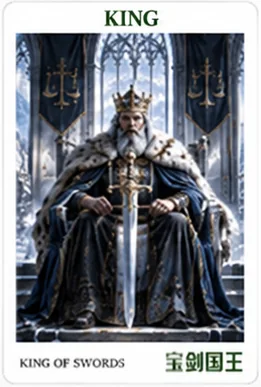
King of Swords宝剑国王
Air: thought, communication, conflict, decision
- Upright
- intellect, authority, strategy, fairness, clarity, truth
- Reversed
- abuse of power, coldness, manipulation, harshness, tyranny
What this card is about
The King of Swords sits on a stone throne, holding a sword upright in his right hand, pointing toward the sky. His gaze is sharp and calm, set against a clear blue sky, symbolizing clarity of mind and impartial judgment. The element of Air grants him swift thought and articulate communication; he embodies reason and authority.
Upright, the King of Swords represents intellect, authority, strategy, and fairness. In relationships, he may appear as a partner or friend who values honest communication and principled behavior. At work, he could be a decisive leader or advisor, respected for logic and integrity. For personal growth, he encourages using reason to make wise decisions and to speak one's truth with clarity.
Reversed, he may indicate abuse of power, coldness, or manipulation. He warns against using intellect as a weapon or becoming overly critical. Reflection: Am I communicating with fairness and empathy?
Updated 2026-10-01
Meaning by situation
King of Swords · In love and relationships
In relationships, King of Swords upright can show a pattern of clear communication and mutual respect for boundaries. You might feel drawn to discuss practical plans or make decisions together calmly. Reversed, it may appear as coldness or criticism, where logic is used to dismiss feelings, or you might notice yourself or a partner avoiding emotional openness. Notice your own needs: do you speak honestly and listen without judgment? Focus on observable interactions, not assumptions about the other person's thoughts.
King of Swords · At work and in your career
At work, King of Swords upright often points to situations needing clear strategy, fair evaluation, or professional judgment. You might be asked to make decisions, organize information, or mediate differences. Reversed, it can show misuse of authority, rigid communication, or an overly critical environment that feels stifling. This card doesn't predict outcomes, but invites you to notice whether your contributions are treated fairly and how you voice your professional views. In job search or collaboration, communicating with facts and logic tends to be more effective than emotional confrontation.
King of Swords · For personal growth
The King of Swords invites you to practice clear honesty in personal growth: being truthful with yourself and others without aggression. Notice when you use logic to hide feelings, or when you stay silent to avoid conflict. Before important conversations, write down your core needs and consider the other person's perspective. This card also encourages independent thinking—not blindly following authority, nor opposing for its own sake. Each choice for clarity over vagueness strengthens your inner fairness and self-knowledge.
King of Swords · As advice
When the King of Swords appears in an advice position, it suggests a concrete small action: take a quiet moment today to write down a recent decision you've been wrestling with. List the facts, your feelings, and possible next steps, then circle the one that aligns most with your values. This helps you find clarity amid confusion.
Using it in a reading
When King of Swords comes up, ask yourself:
- When did I last use logic to talk myself out of a feeling?
- In a recent important conversation, did I express my needs clearly and listen to the other person?
- How do I tell the difference between sound authority and manipulative demands?
Then read it with its position and neighbours; the whole spread refines a single card.
Common questions about King of Swords
Is this card good or bad in love?
No absolute good or bad. Upright often means rational communication and clear boundaries; reversed can bring coldness or verbal pressure. Look at mutual respect.
What does the reversed meaning indicate?
Reversed may reflect misuse of power, coldness, or manipulation, or it can show defensiveness in communication. It invites you to notice equality and warmth.
Does the King of Swords represent a specific person?
Not necessarily. It describes an energy of reason, authority, or communication style—could be you, another, or the atmosphere, not a specific individual.
More from Swords
Tarot offers reflection; card meanings are not a promise of any outcome.